Ever had that sinking feeling when you realized the charming street performer who “gave” you a friendship bracelet is now demanding €50? You’re not alone — 71% of tourists face some type of scam attempt during international travel.
The global scamming industry doesn’t discriminate. From Rome’s “free” roses to Bali’s rigged taxi meters to New York’s fake Buddhist monks, tourist scams work around the world because they exploit the same human vulnerabilities: unfamiliarity, politeness, and vacation-brain.
In this guide, you’ll discover how to spot the 12 most common tourist scams before they happen, complete with real traveler stories and psychological tricks scammers use to bypass your normal defenses.
But first, let’s talk about why even the smartest travelers fall for these tricks, and it’s not what you think.
The Psychology Behind Tourist Scams
Why Tourists Make Perfect Targets
Travelers wandering through unfamiliar streets with maps and cameras might as well wear signs saying “I’m not from around here.” That’s exactly what scammers are counting on.
Tourists carry more cash, valuable electronics, and often lack local connections to help when things go sideways. They’re operating outside their comfort zones in places where they don’t speak the language and don’t understand local customs.
Think about it—when was the last time you walked around your hometown with your passport in your pocket and $500 in cash? But that’s exactly what many travelers do.
The worst part? Most tourists are in vacation mode. They’re relaxed, open to new experiences, and their guard is naturally lower. The psychological switch from everyday vigilance to “fun time” makes them prime candidates for manipulation.
How Scammers Exploit Unfamiliarity
The moment you step off that plane, you’re at a massive disadvantage. Scammers exploit this gap mercilessly.
They know you:
- Don’t know what things should cost
- Can’t tell official staff from imposters
- Need help navigating
- Might not recognize local scam patterns
Ever been approached by a friendly local pointing out that the museum is closed today, but they know another amazing place? That’s unfamiliarity exploitation 101.
Scammers also leverage time pressure. When you’re rushing to catch a train or find your hotel, your decision-making suffers. You’ll pay that overpriced taxi fare just to solve your immediate problem.
The Role of Trust in Successful Scams
Trust is the currency scammers trade in. They’re not just taking your money—they’re harvesting your natural inclination to trust others.
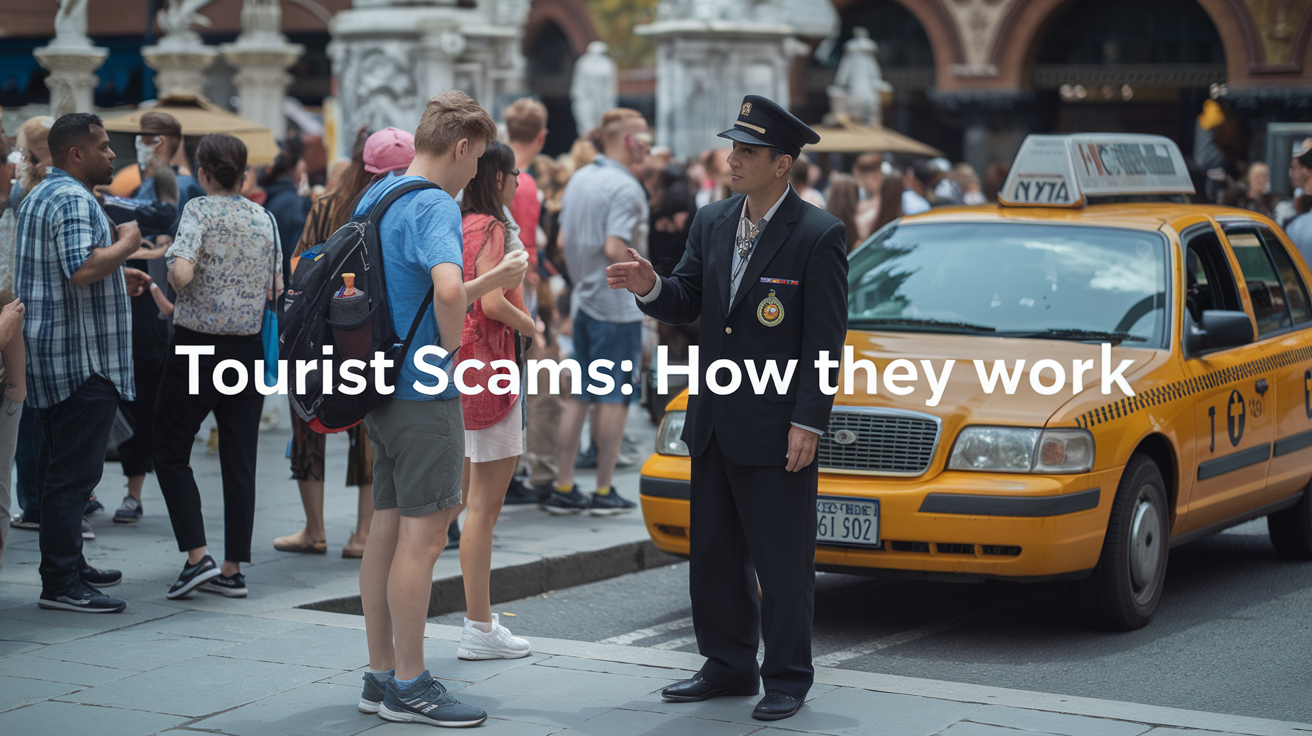
The most successful scammers don’t look shady. They appear as helpful hotel staff, friendly students practicing English, or official-looking transportation workers. They create an impression of legitimacy through uniforms, badges, or even official-looking documents.
What makes this particularly effective is our tendency to trust authority figures. When someone in what looks like a police uniform tells you something, your brain’s first instinct isn’t skepticism.
The scammer’s goal is simple: create trust quickly, exploit it immediately, and disappear before you realize what happened.
Why People Fall for Scams Even When Warned
You’ve read the warnings. You’ve watched the travel safety videos. You think, “I’d never fall for that.” And yet, seasoned travelers get scammed every day.
The truth? Knowing about scams intellectually doesn’t protect you emotionally. When you’re tired from a long flight, overwhelmed by new surroundings, or simply caught off-guard, your brain takes shortcuts.
These mental shortcuts, called cognitive biases, make us vulnerable:
- Social proof: “Everyone else is doing it, so it must be safe”
- Reciprocity: “They helped me, so I should buy something”
- Fear of missing out: “This is a special opportunity only for today”
Even more powerful is our natural desire to appear competent. Many tourists would rather lose money than admit they’re confused or need help. Scammers know this and create scenarios where speaking up feels more uncomfortable than going along with the scam.
Common Tourist Scam Categories Worldwide
A. Distraction and Pickpocketing Techniques
Ever notice how thieves rarely work alone? That’s because the best pickpocketing crews operate like well-oiled machines.
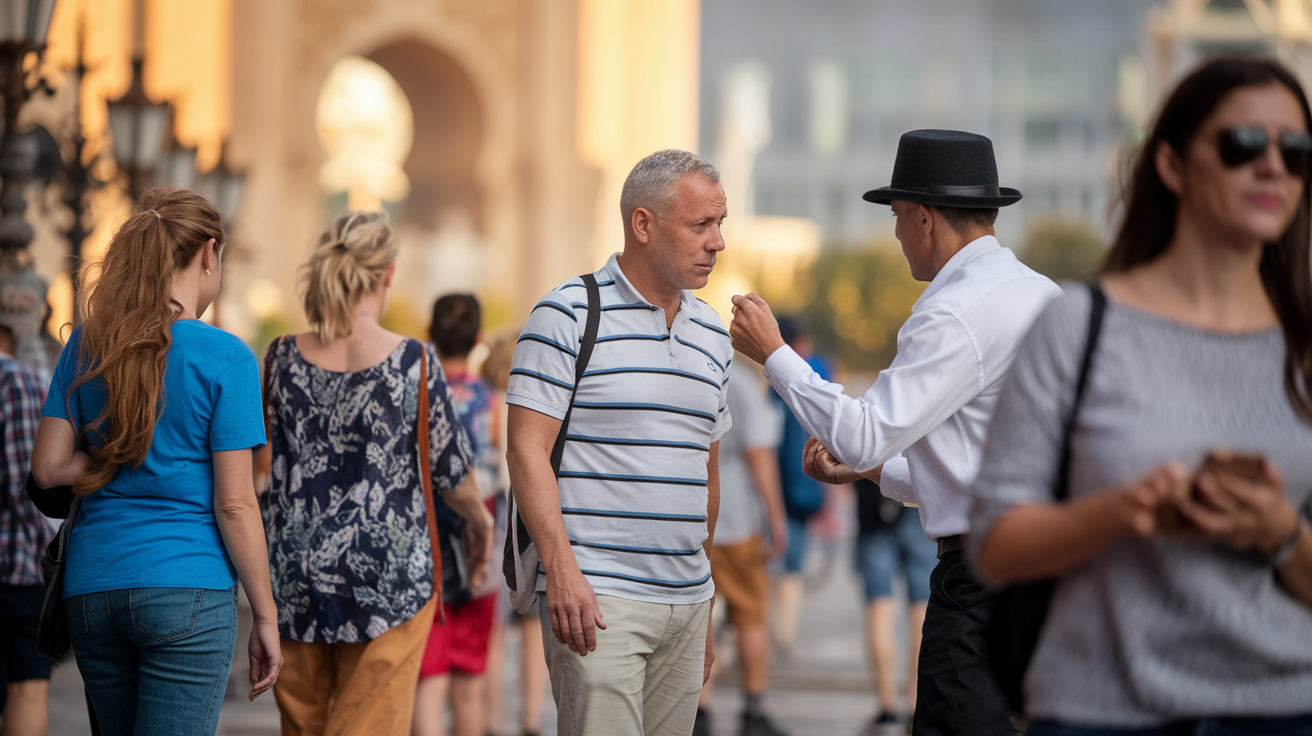
The most common setup involves a team of 2-3 people. One creates a distraction (bumping into you, asking for directions, or even “accidentally” spilling something on your clothes), while their partner swoops in for your valuables. By the time you realize what happened, they’re long gone.
Some classic distractions include:
- The “baby toss” (someone throws a doll at you, triggering your instinct to catch it)
- Fake petitions that keep your hands and eyes occupied
- Street performances that draw crowds—perfect hunting grounds
- The “broken camera” trick where someone asks you to take their photo
In crowded tourist spots like Barcelona’s Las Ramblas or Rome’s Termini Station, pickpockets target travelers carrying backpacks, using smartphones, or those standing on packed public transportation. They’re looking for the telltale signs: the map-checker, the person with a bulging back pocket, or anyone wearing expensive watches or jewelry.
The scary part? Many victims don’t even realize they’ve been robbed until hours later. I once watched a team working the Paris metro—one guy “accidentally” got his bag stuck in the closing doors while his partner emptied the pockets of helpful bystanders.
B. Overcharging and Price Manipulation Schemes
This is probably the most widespread tourist scam because it’s so damn effective. You’re in a new country, unfamiliar with the currency, and have no idea what things should cost.
The markup on tourist prices can be outrageous:
- Taxi drivers who “forget” to start the meter
- Restaurants with separate “tourist menus” (often in English with prices 3-4 times higher)
- Street vendors who quote one price then demand more after the service
- Bars that add mysterious “cover charges” or “service fees” to your bill
In Venice, a café near St. Mark’s Square recently charged tourists €82 ($95) for two coffees and two bottles of water. When the customers complained, the staff pointed to the fine print. Perfectly legal. Completely unethical.
The currency confusion scam is especially sneaky. A vendor in Thailand might say “fifty” for an item, letting you assume it’s 50 baht (about $1.50) when they actually mean 50 USD. Or they’ll “accidentally” give change in a similar-looking but less valuable currency.
Dynamic pricing is another trick. The price magically increases based on:
- How expensive your clothes look
- Whether you’re carrying a guidebook
- If you speak the local language
- How many people are in your group
C. Fake Official Scams (Police, Tour Guides, etc.)
Nothing makes your stomach drop faster than being approached by “police officers” in a foreign country.
These scammers count on your respect for authority and your fear of breaking unfamiliar laws. They’re banking on the fact that most tourists don’t know what real local police uniforms look like.
The classic version goes like this: Two “officers” approach you, claim there’s a problem with counterfeit currency, and insist on checking your wallet. During the “inspection,” they swap your real money for fakes or simply palm some bills.
Fake officials come in many forms:
- “Tourism police” who fine you for made-up violations
- “Health inspectors” claiming your hotel is closed for violations
- “Government workers” selling fake permits or entrance tickets
- “Security guards” demanding special fees at attractions
In Rome, unofficial tour guides hang around the Colosseum offering to help you “skip the line” for an additional fee. They wear lanyards and carry clipboards to look official. Once they have your money, they either disappear or provide worthless information.
The most dangerous version happens in some Southeast Asian countries, where fake police confiscate passports or threaten arrest unless you pay a “fine” on the spot. Never hand over your passport—offer a photocopy instead.
D. Transportation Cons (Taxis, Tuk-tuks, Rental Scams)
Transportation scams are particularly effective because they target you when you’re most vulnerable—right after a long flight, tired and disoriented in a new place.
The rigged meter scam is a classic. Taxi drivers modify their meters to run at 2-5 times the normal rate. In Bangkok, I once watched the meter jump 100 baht every 30 seconds. When I pointed it out, the driver claimed it was a “night rate” (it wasn’t).
Other transportation traps include:
- The “broken meter” excuse, followed by an outrageous flat rate
- Taking unnecessarily long routes to run up the fare
- Claiming your hotel is closed/dangerous and taking you to one that pays commissions
- Rental companies that photograph existing damage, then blame you for it later
In tourist-heavy cities like Prague and Istanbul, some taxi drivers keep a stack of large bills to perform the “wrong change” trick. They flash the correct change, but hand you smaller denominations, then argue when you call them out.
Tuk-tuk and rickshaw drivers in Southeast Asia often offer “special city tours” for impossibly low prices. The catch? They’ll take you to overpriced shops where they earn commissions on everything you buy.
Car rental scams are particularly costly. Companies advertise low daily rates, then pile on “mandatory” insurance, fees for additional drivers, and charges for “premium” features like GPS. Always take dated photos of the car from every angle before driving off the lot.
E. Accommodation and Booking Frauds
Nothing ruins a vacation faster than arriving at your “beachfront villa” to find it’s either non-existent or nothing like the photos.
Accommodation scams have exploded with the rise of vacation rental platforms. Scammers create listings using stolen photos, collect deposits, then vanish. Or they substitute a completely different property when you arrive, claiming the original had “emergency maintenance issues.”
The bait-and-switch tactic works like this:
- You book a beautiful hotel room online
- On arrival, you’re told that room is “unavailable”
- They offer an inferior room at the same price
- If you complain, they claim they’re fully booked
Some accommodations also hit you with hidden fees that weren’t disclosed during booking: resort fees, cleaning charges, amenity fees, or local taxes that suddenly appear on your bill.
In tourist hotspots like Bali and Phuket, “travel agencies” set up shop offering discounted bookings for hotels and activities. They take your payment but only make a partial reservation or none at all, pocketing the difference.
Another increasingly common scam involves fake rental listing sites that mimic legitimate platforms like Airbnb or Booking.com. They offer amazing deals to lure you away from the real site, then steal your payment information.
The most devious version is the “WiFi honeypot” in hotels—fake networks set up to capture your login credentials when you connect. Always verify the official hotel network name at reception.
Regional Scam Variations and Hotspots
Technology’s Impact on Modern Tourist Scams
Social Media Reconnaissance: How Scammers Find Targets
Gone are the days when tourists were random targets. Now? Scammers stalk your Instagram stories before you even board your flight.
That beautiful selfie at the airport with your boarding pass partially visible? Big mistake. Your excited Facebook post about your upcoming two-week Italian adventure? You just announced an empty house.
Scammers scrape public posts, track location tags, and analyze hashtags to build detailed profiles of potential victims. They know when you’re arriving, where you’re staying, and even what attractions you plan to visit.
I’ve seen tourists get approached by “friendly locals” who somehow knew their names and home countries. Creepy, right? That’s because they’d already seen all their public posts tagged #DreamVacation.
Digital Payment and ATM Scams
Ever notice those sketchy ATMs in tourist areas? They’re not just ugly—they’re dangerous.
Skimming devices now are so sophisticated they’re practically invisible. Some scammers have moved beyond physical tampering to hacking the actual ATM software.
Then there’s the tap-and-go nightmare. Contactless payment cards are convenient, but in crowded areas, tech-savvy thieves use hidden card readers to process payments just by standing close to you.
And don’t get me started on those “helpful” currency exchange apps that promise great rates but actually:
- Install malware on your phone
- Collect your banking credentials
- Create fake transaction screens while emptying your account
Fake Apps and QR Code Deceptions
The QR code renaissance post-pandemic created a scammer’s paradise.
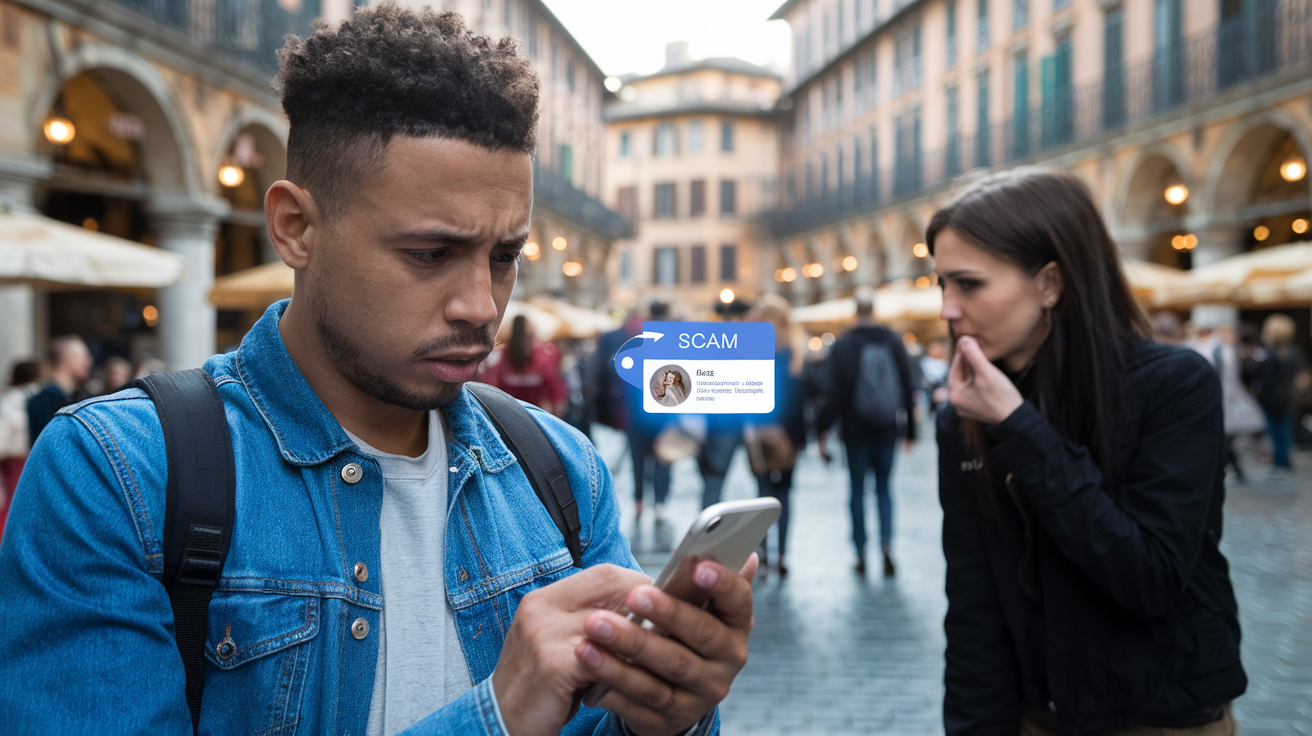
Picture this: You’re at the Eiffel Tower, and there’s a QR code offering “Skip-the-line tickets.” Scan it, and boom—you’ve just downloaded malware or visited a payment page that steals your credit card info.
Fake city guide apps are another goldmine for scammers. They look legitimate in app stores but:
- Track your location constantly
- Access your camera and microphone
- Harvest personal data
- Sometimes even lock your phone for ransom
The worst part? They often work just well enough that you don’t delete them immediately.
Vacation Rental and Online Booking Frauds
That dream villa in Santorini for half the normal price? If it seems too good to be true… well, you know the rest.
Online booking scams have evolved beyond simple fake listings. Modern scammers create entire fake booking platforms that mimic popular sites down to the last detail.
Some tactics include:
- Cloning legitimate property listings with altered contact info
- Creating time pressure with fake “3 other people looking at this property” notifications
- Setting up elaborate verification processes designed to collect your personal data
- “Accidentally” overcharging then offering refunds through sketchy methods
The most sophisticated scammers even have fake customer service teams that keep you on the hook until your actual vacation dates arrive—and you’re standing outside a property that was never actually for rent.
Wi-Fi and Public Network Vulnerabilities
Free Wi-Fi is the ultimate tourist trap of the digital age.
That “Airport_Free_WiFi” network? Probably set up by someone sitting nearby harvesting your data. Even legitimate networks in cafés and hotels aren’t much safer.
Man-in-the-middle attacks are now so common that your data is essentially being read like an open book when you connect to public networks. Passwords, credit card numbers, private messages—all up for grabs.
Some scammers have even started setting up evil twin networks—fake Wi-Fi hotspots with names nearly identical to legitimate ones. The slight misspelling of “Hilton_Guest” as “Hilton-Guest” might go unnoticed, but the consequences won’t.
And it’s not just about stealing data anymore. These networks can also be used to push malware directly to your device, turning your vacation photos into ransomware bait.